


By this point, the shape of the argument should be clear.
The physical world is becoming more visible. The stack explains how that visibility becomes more usable. Applications play different roles within that environment. A stronger stack improves what an organisation is able to see, judge and do — and creates the conditions in which the Intelligence layer of the stack can become genuinely useful. The Five Laws explain why some environments become more dependable while others remain fragile.
So the obvious final question is this: what happens when AI enters the picture?
The short answer is that the promise is real. But so is the dividing line.
AI can help infrastructure organisations search more intelligently, compare more widely, recognise patterns earlier, navigate complexity faster and support decisions with more speed and precision than many environments have been able to achieve before.
That matters because roads, rail, utilities and buildings are not short of complexity. They are short of clear, joined-up understanding delivered early enough to shape better action.
That is where AI becomes genuinely interesting. Not as theatre, and not as a layer of synthetic confidence laid over weak foundations, but as a way of widening what a stronger environment is already able to see, compare, interpret and improve.
That is the opportunity.
In utilities, it may mean stronger analysis across networks, demand, resilience, intervention history and AMP planning. In rail, it may mean better understanding of the relationship between condition, delay, maintenance, performance and passenger impact. In roads, it may mean a clearer picture of how congestion, incidents, asset condition and intervention choices affect network flow and service outcomes. In buildings and estates, it may mean better understanding of the relationship between comfort, controls, occupancy, maintenance, energy and carbon performance.
Once the environment becomes more connected, the Intelligence layer of the stack starts to carry more weight. AI is no longer working on isolated records or partial views. It is working on something closer to an operating picture.
And that changes what becomes possible.
Search becomes more useful. Comparison becomes more meaningful. Pattern recognition becomes more valuable. Decision support becomes more credible. The organisation has a better chance of seeing emerging pressure before it becomes disruption, cost or failure.
In the stronger environments, the value does not stop at better visibility. It starts to become predictive.
That is when AI starts to widen the value of the stack in a more serious way — not simply by describing the environment more quickly, but by helping it become more anticipatory, more responsive and more capable of supporting better-timed action.
That is where the difference will start to show.
Some organisations will use AI to widen the practical value of a stronger stack. Others will discover that AI does not compensate for weak capture, thin structure, fragile governance or disconnected applications nearly as well as they hoped.
That is where disappointment will sit.
Not because AI has failed, but because the environment underneath it has not been strengthened enough to carry what AI is being asked to do.
That is why stronger foundations matter more now, not less.
And it is also why the real promise of AI is not just prediction. It is better understanding — earlier, broader, more connected and more useful in time to shape action.
That is where the Northbridge example becomes helpful.
Ten years on, Northbridge is no longer relying on disconnected inspections, isolated telemetry, partial maintenance history and awkward reporting stitched together after the event. It is working in a stronger signal environment. Inspection evidence, monitoring, asset context, operational conditions, route performance and intervention history can now be seen in relation to one another much more clearly.
That does not remove judgement. But it changes the quality of it.
Engineers can see deterioration patterns earlier. Maintenance and FM teams can move from reactive response towards more condition-based intervention. Operators gain a stronger basis for planning, prioritisation, cost control and negotiating with contractors. It also improves the basis for workforce planning, helping operators allocate internal teams, specialist skills and contractor support more intelligently — and with less dependence on guesswork, reactive demand and repeated rework. Operational teams can understand whether local disruption is isolated or part of a wider pattern. Leadership can see cost, condition, service, disruption and public impact with more coherence.
And AI can begin to widen that value further. It can help search the environment more intelligently. It can help surface patterns that would otherwise stay buried. It can help connect comparisons across time, route, estate or portfolio. It can help support earlier and more targeted decisions.
Over time, it can help turn a stronger environment into one that is not only more understandable, but more adaptive, better timed and better able to support intervention across the wider operating picture.
In the strongest environments, that progression does not stop there. It becomes iterative.
Better intelligence supports better decisions and actions.
Better decisions and actions create operational change.
And that operational change produces the next round of signals in return.
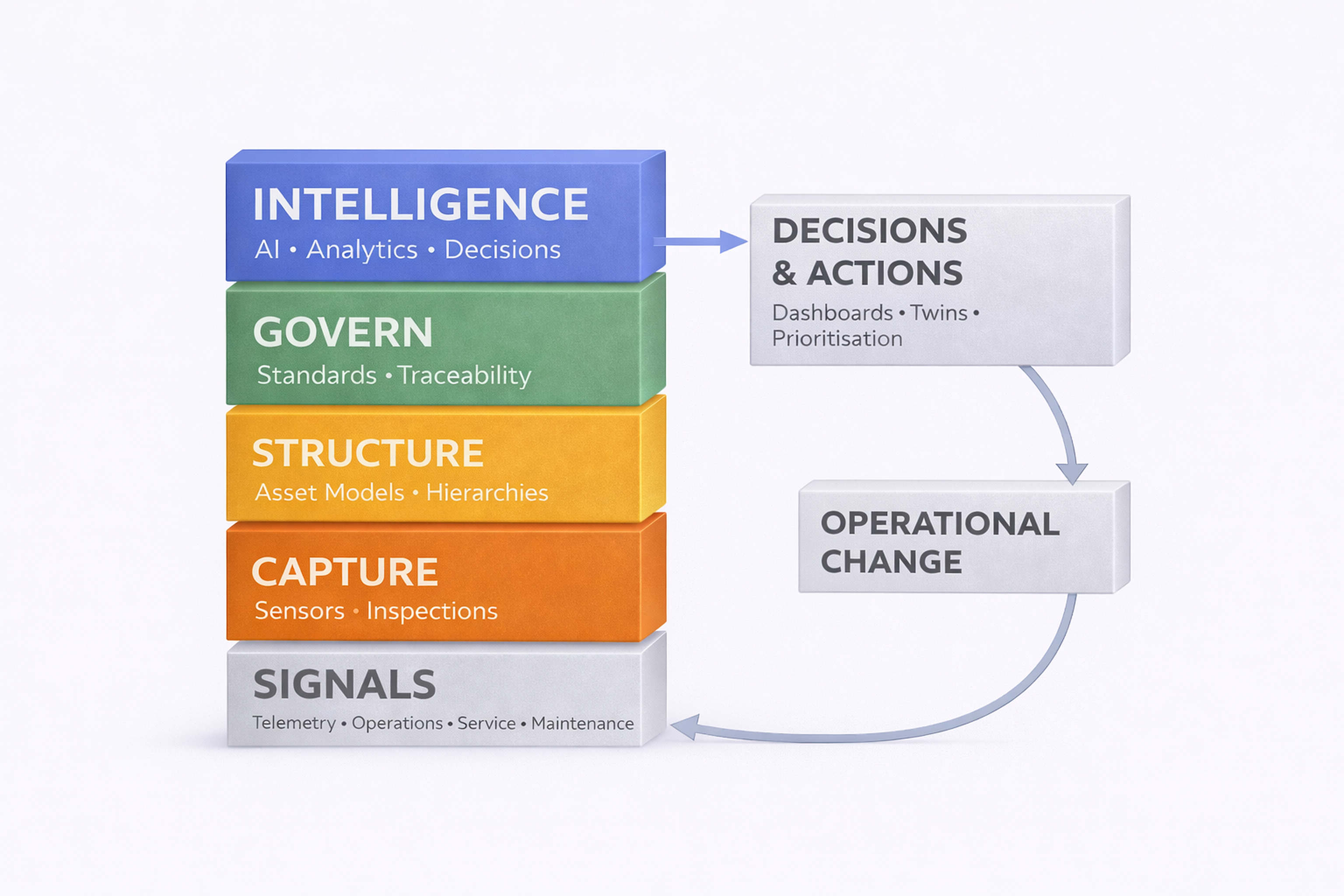
That is when the environment starts to look less like a set of systems and more like an operating loop — not just in isolated pilots or local use cases, but across the wider organisation.
Signals are captured more consistently.
Intelligence becomes more useful.
Decisions become better timed.
Actions become better targeted.
Operational change becomes more deliberate.
And the next round of signals comes back into a stronger environment again.
That is the more ambitious prize.
Not simply more AI.
But a more elegant operating environment — one that becomes progressively better at sensing, interpreting, deciding and improving.
That also starts to change the balance of control. When the picture is clearer, operators are in a better position to plan ahead, challenge unnecessary reactive spend, negotiate with contractors from a stronger footing and make better-informed decisions about budgets, service levels, workforce allocation and intervention timing.
Over time, that loop becomes more adaptive, more iterative and, in the strongest environments, more optimised.
So the real promise is not just that AI helps organisations know more.
It is that it helps improve the loop between evidence, judgement, action and operational change.
That is a much more serious ambition.
And a much more useful one.
So yes, AI matters.
It matters a great deal.
But the organisations that benefit most will not be the ones making the loudest claims. They will be the ones that have done the harder work underneath — strengthening the environment, improving the foundations and building the conditions in which better intelligence can actually carry weight.
That, to me, is where the opportunity sits.
And it is also where this Foundation series ends.
The framework is now in place.
The more interesting question is what stronger foundations make possible in the real world — where the real bottlenecks sit, where value is being lost and how infrastructure organisations can start improving the environment they already have.
That is where I go next.